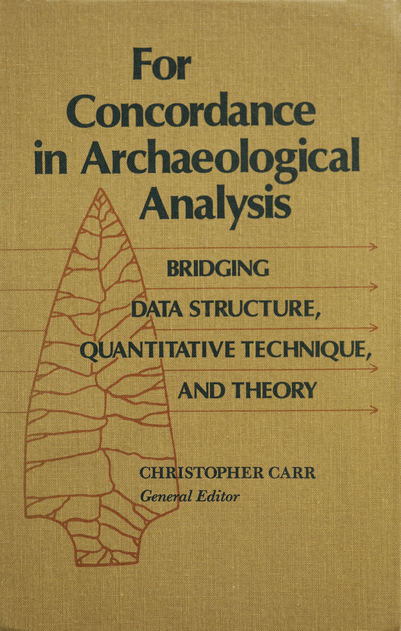
1989 For Concordance in Archaeological Analysis: Bridging Data Structure, Quantitative Technique, and Theory, edited by C. Carr. Softbound edition. Waveland Press, Prospect Heights, IL. 648 pp.
1985 For Concordance in Archaeological Analysis: Bridging Data Structure, Quantitative Technique, and Theory, edited by C. Carr. Hardbound edition. Westport Publishers, Kansas City, MO. 622 pp.
1985 For Concordance in Archaeological Analysis: Bridging Data Structure, Quantitative Technique, and Theory, edited by C. Carr. Hardbound edition. Westport Publishers, Kansas City, MO. 622 pp.
Summary
[Summary forthcoming]
Reviews
Review of For Concordance in Archaeological Analysis, American Anthropologist 1987, 89(2), pp. 459-460. Jack D. Nance.
Review of For Concordance in Archaeological Analysis, Quarterly Review of Archaeology 1986, 7(1), pp. 1, 15-16. Fekri A. Hassan.
Review of For Concordance in Archaeological Analysis. On Web, April 2000. J. Bryan Mason.
Review of For Concordance in Archaeological Analysis, Quarterly Review of Archaeology 1986, 7(1), pp. 1, 15-16. Fekri A. Hassan.
Review of For Concordance in Archaeological Analysis. On Web, April 2000. J. Bryan Mason.
Table of Contents
Part I. General Introduction
|
Chapter 1.
|
Perspective and Basic Definitions. Christopher Carr
|
Part II. Philosophical Framework
|
Chapter 2.
|
Getting into Data: Philosophy and Tactics for the Analysis of Complex Data Structures. Christopher Carr
|
|
Chapter 3.
|
The Substance of Archaeological Analysis and the Mold of Statistical Method: Enlightenment Out of Discordance? Dwight W. Read
|
Part III. Data Organization and Data Base Management
|
Chapter 4.
|
Introductory Remarks on Data Base Management. Christopher Carr
|
|
Chapter 5.
|
Archaeological Data Base Management as Conceptual Process. Sandra Parker, W. Fredrick Limp, and James A. Farley
|
Part IV. Regional Analysis
|
Chapter 6.
|
Introductory Remarks on Regional Analysis. Christopher Carr
|
|
Chapter 7.
|
The Analysis of Decision Making: Alternative Applications in Archaeology. W. Fredrick Limp and Christopher Carr
|
|
Chapter 8.
|
Predictive Modeling of Site Settlement Systems Using Multivariate Logistics. Sandra Parker
|
|
Chapter 9.
|
Determining Empirical Relationships between the Natural Environment and Prehistoric Site Locations: A Hunter-Gatherer Example. Kenneth L. Kvamme
|
|
Chapter 10.
|
Constraints on Linear Programming Applications in Archaeology. Arthur S. Keene
|
|
Chapter 11.
|
Notions to Numbers: Great Basin Settlements as Polythetic Sets. Leonard Williams, David Hurst Thomas, and Robert Bettinger
|
Part V. Intrasite Spatial Analysis
|
Chapter 12.
|
Introductory Remarks on Intrasite Spatial Analysis. Christopher Carr
|
|
Chapter 13.
|
Alternative Models, Alternative Techniques: Variable Approaches to Intrasite Spatial Analysis. Christopher Carr
|
|
Chapter 14.
|
The Contiguity-Anomaly Technique for Analysis of Spatial Variation. Bruce G. Gladfelter and Clifford E. Tiedemann
|
Part VI. Artifact Analysis
|
Chapter 15.
|
Introductory Remarks on Artifact Analysis. Christopher Carr
|
|
Chapter 16.
|
Absolute Seriation: A Time-Series Approach. David P. Braun
|
|
Chapter 17.
|
The Use of Technological Indices: A Case Study for the Levantine Mousterian. Marcia L. Jones
|
|
Chapter 18.
|
Projectile Point Maintenance and Typology: Assessment with Factor Analysis and Canonical Correlation. C. Marshall Hoffman
|