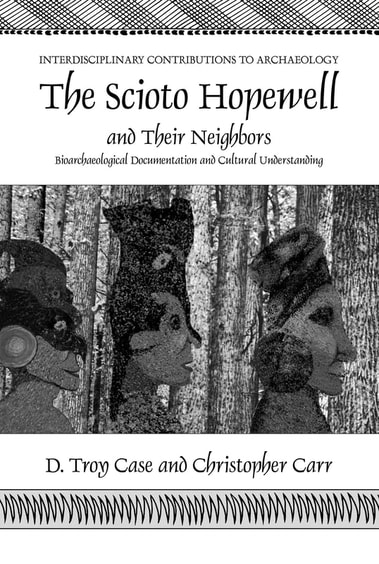
2008 The Scioto Hopewell and Their Neighbors: Bioarchaeological Documentation and Cultural Understanding, by D. Troy Case and Christopher Carr. Springer, New York, NY.
2008 Compact Disk of Appendices, ISBN 978-0-387-77386-5. D. T. Case, C. Carr, et al. The Scioto Hopewell and Their Neighbors: Bioarchaeological Documentation and Cultural Understanding, by D. Troy Case and Christopher Carr. Springer, New York, NY. https://extras.springer.com/2008/
2008 Compact Disk of Appendices, ISBN 978-0-387-77386-5. D. T. Case, C. Carr, et al. The Scioto Hopewell and Their Neighbors: Bioarchaeological Documentation and Cultural Understanding, by D. Troy Case and Christopher Carr. Springer, New York, NY. https://extras.springer.com/2008/
Summary
This book presents, for the first time, a detailed, holistic synthesis of the lifeways, culture, history, and material record of the ceremonially and socially rich Hopewell peoples who lived in the Scioto valley and neighboring areas in Ohio in the first centuries A.D. The Scioto Hopewell built monumental, 80 acre earthworks aligned precisely to astronomical events, masterfully worked glistening metals and semiprecious stones into elegant designs, and honored their dead with these vocal artifacts in community burial houses two-thirds the size of a football field. The Scioto Hopewell’s intricate social order and religious concepts of alliance afforded them three centuries of intercommunity peace. The first half of the work, written in the vein of classic ethnographies that focus on a local group in context, thickly describes the local, natural and symbolic environmental setting, subsistence and settlement pattern, community and sociopolitical organization, ceremonial organization, intercommunity dynamics, and world views of Scioto Hopewell peoples. By taking an encompassing and historical view of Scioto Hopewell life, both its origins and ending are revealed. These detailed cultural and historical reconstructions are strongly anchored empirically in the second half of the book. The data bases document the archaeological and human remains from all 52 Ohio Hopewell ceremonial centers that have been excavated and reported; the intrasite layouts and precise geographic placements of most of these centers as well as the locations of many other, unexplored ones; and the ceremonial functions, meanings, and social role associations of 51 kinds of historic Woodland Native American ceremonial paraphernalia analogous to those used and interred by Ohio Hopewell peoples. The book is also liberally illustrated with photographs and drawings of Scioto Hopewell artwork, ceremonial paraphernalia, sites, and landscapes. The authors share all these data, along with many insights about key, future research topics, with the hope that others will use them to continue to pursue the empirically rich, holistic, and humanized understanding of Ohio Hopewell peoples begun in this book.
Reviews
Review of The Scioto Hopewell and Their Neighbors, American Anthropologist 2010, 112(4), pp. 657-692. Lynne Schepartrz et al.
Review of The Scioto Hopewell and Their Neighbors, Antiquity 2009, 38(322), pp. 1203-1204. George R. Milner.
Review of The Scioto Hopewell and Their Neighbors, Journal of Anthropological Research 2010, 66(3), pp. 428-429. Ann M. Palkovich.
Review of The Scioto Hopewell and Their Neighbors, Antiquity 2009, 38(322), pp. 1203-1204. George R. Milner.
Review of The Scioto Hopewell and Their Neighbors, Journal of Anthropological Research 2010, 66(3), pp. 428-429. Ann M. Palkovich.
Table of Contents
Part I. Rationale and Framework
|
Chapter 1.
|
Documenting the Lives of Ohio Hopewell People: A Philosophical and Empirical Foundation. Christopher Carr and D. Troy Case
|
Part II. The Scioto Hopewell: Land, People, Culture, and History. Christopher Carr
|
Chapter 2.
|
Environmental Setting, Natural Symbols, and Subsistence. Christopher Carr
|
|
Chapter 3.
|
Settlement and Communities. Christopher Carr
|
|
Chapter 4.
|
Social and Ritual Organization. Christopher Carr
|
|
Chapter 5.
|
World View and the Dynamics of Change: The Beginning and the End of Scioto Hopwell Culture and Lifeways. Christopher Carr
|
Part III. Inventory and Documentation. D. Troy Case and Christopher Carr
|
Chapter 6.
|
Documenting the Ohio Hopewell Mortuary Record: the Bioarchaeological Data Base. D. Troy Case and Christopher Carr
|
|
Chapter 7.
|
Ceremonial Site Locations, Descriptions, and Bibliography. D. Troy Case and Christopher Carr
|
|
Chapter 8.
|
Definition of Variables and Variable States. D. Troy Case, Christopher Carr, and Ashley E. Evans
|
|
Chapter 9.
|
Evaluating the Consistency of Age and Sex Assessments of Ohio Hopewell Human Remains by Previous Researchers. D. Troy Case
|
|
Chapter 10.
|
Aging and Sexing Human Remains from the Hopewell Site. Cheryl A. Johnston
|
|
Chapter 11.
|
The Functions and Meanings of Ohio Hopewell Ceremonial Artifacts in Ethnohistoric Perspective. Christopher Carr, Rex Weeks, and Mark Bahti
|
|
Chapter 12.
|
Contextualizing Preanalyses of the Ohio Hopewell Mortuary Data, I: Age, Sex, Burial-Deposit, and Intraburial Count Distributions. Christopher Carr, Beau J. Goldstein, and D. Troy Case
|
|
Chapter 13.
|
Contextualizing Preanalyses of the Ohio Hopewell Mortuary Data, II: Associations of Artifact Classes across Burials. Christopher Carr
|
|
Chapter 14.
|
Data Accuracy and Precision: A Comparison of the HOPEBIOARCH Data Base to N. Greber’s and T. Lloyd’s Data Bases. Christopher Carr, Beau J. Goldstein, and D. Troy Case
|
Part IV. Future Directions. Christopher Carr
|
Chapter 15.
|
Coming to Know Ohio Hopewell Peoples Better: Topics for Future Research, Masters’ Theses, and Doctoral Dissertations. Christopher Carr
|